

This is a follow-up to what I shared recently about echo chambers and the danger of certainty. That piece was about how we do this on a global scale. This one is about how we do it to each other. In our friendships. In our families. In our communities. In the groups we call sacred.
Here's a pattern I've watched unfold more times than I can count, in my own life and in the lives of the people I work with. I want to name it clearly because I think it's one of the most quietly destructive dynamics in human relating, and almost nobody talks about it.
How the story begins
Someone gets triggered by another person. Maybe they were hurt. Maybe they felt unseen, dismissed, or betrayed. Maybe something real happened, or maybe something landed on top of an old wound and the two became indistinguishable. All of that is valid. All of that deserves to be felt.
But here's where it goes sideways.
Instead of going to the person and saying, "Something happened for me and I want to understand it better," they turn inward. They run the story through their own filters. They consult their intuition. They feel into it somatically. And they arrive at a conclusion about who that person is. Not based on curiosity. Not based on dialogue. Based on an internal read that hasn't been checked externally.
Self-referencing reality confirmation
I call this self-referencing reality confirmation. And it sounds like this: "I just know." "I can feel it." "My body told me." "I trust my gut on this one."
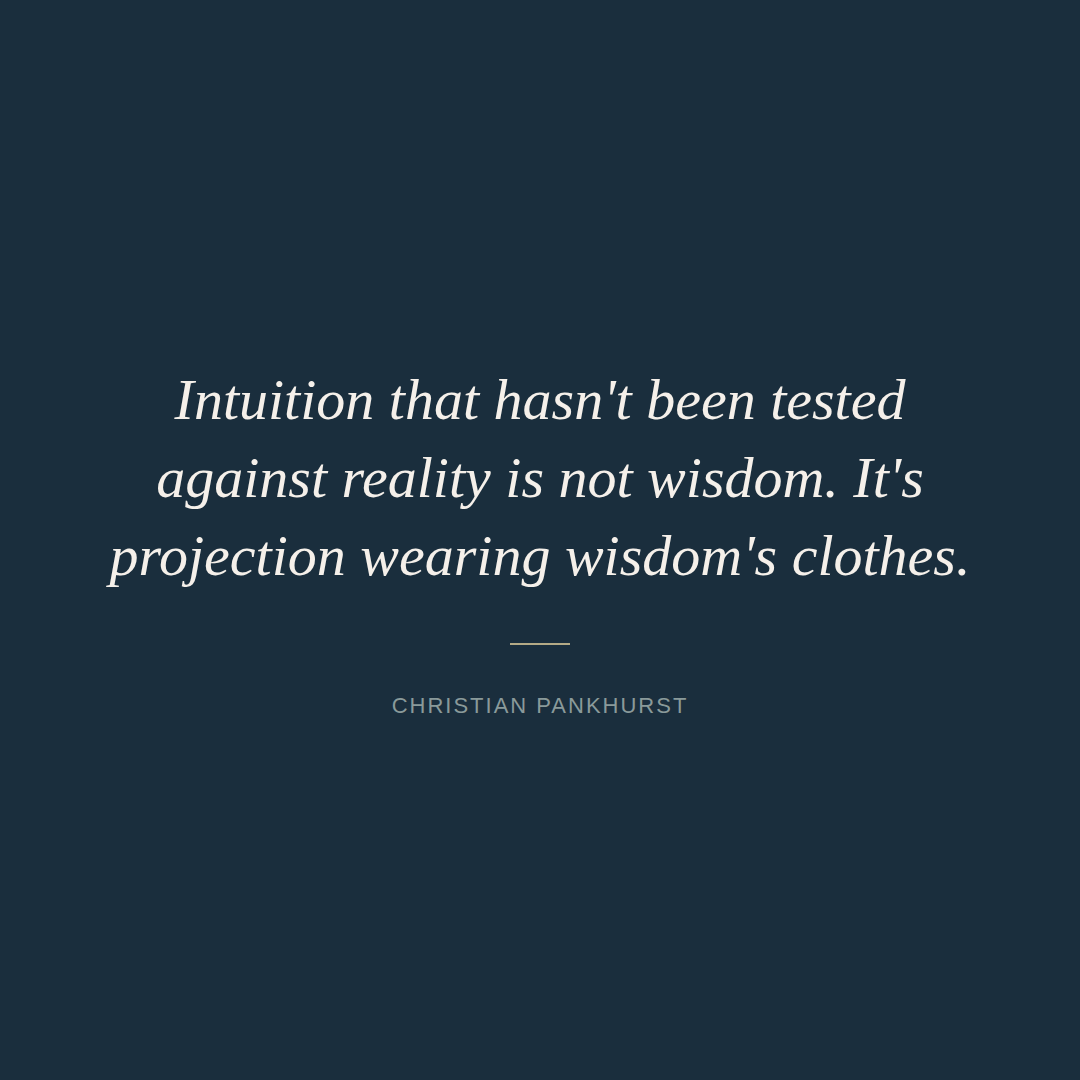
Here's the thing. Many of these people ARE deeply intuitive. Many of them DO have a powerful felt sense that carries real wisdom. I'm not dismissing that for a second. But intuition that hasn't been tested against reality is not wisdom. It's projection wearing wisdom's clothes. Because our felt sense doesn't come to us clean. It comes through layers of trauma, of transference, of old relational wounds that have nothing to do with the person in front of us. And if we can't track those layers, if we don't even know they're there, then we end up trusting a read that's more about our past than the present moment.
How distortion recruits
That alone would be painful enough. But it doesn't stop there.
What happens next is the part that does the real damage. The person takes their unchecked story and shares it with others. And if those others carry a similar wound, a similar trauma signature, something in them resonates. Not because the story is true, but because it activates their own unresolved material. And now they believe it too. Not because they investigated. Not because they asked questions. Because it felt true in their body, and feeling true is enough.
Now you have a group. A group united not by shared truth but by shared wounding. And nobody in that group has gone to the source. Nobody has said, "Before I buy into this, let me hear the other side." Nobody has risked the vulnerability of staying in the question rather than settling into the certainty of the answer.
This is how alliances form around distortion. This is how communities fracture. This is how people who once loved each other end up in silent, permanent standoffs where nobody remembers what actually happened, only what the story became after it passed through enough wounded filters.
Both sides of the mirror
I've been on both sides of this. I've been the one who bought into a story without checking. And I've been the one whose story was written by others without ever being asked. Neither side is comfortable to sit with. Both have taught me something I now hold as one of the most important principles in relational work.
Your intuition is not the final authority on another person's character. It is information. Powerful information. But information that must be held lightly until it's been tested in relationship. Until you've sat across from the person. Until you've asked the questions you're afraid to ask. Until you've let their response land in you without already having decided what it means.
The practice
The practice is this. When you notice a strong read forming about someone, especially if it's negative, especially if it's accompanied by certainty, pause. Ask yourself: have I checked this? Have I gone to the source? Or have I only consulted my own internal reference and the people who agree with me?
If the answer is that you haven't checked, you don't yet have truth. You have a hypothesis. And treating a hypothesis as fact, and then recruiting others into it, is one of the most corrosive things we do to each other.
The same pattern, everywhere
This is the same pattern that drives political polarisation. It's the same pattern that fuels online pile-ons. It's the same pattern that turns neighbourhoods against each other and families into factions. Someone forms a view. They share it with people who are primed to agree. The agreement becomes the evidence. And the person at the centre of the story never gets asked.
I'm not saying every intuitive read is wrong. I'm not saying people don't sometimes behave badly and deserve to be named. I'm saying that the read deserves to be tested before it becomes the verdict. And that the willingness to test it, to go to the source, to risk hearing something that might dismantle your certainty, is one of the bravest and most loving things a human being can do.
It's also one of the rarest.
If this has happened to you
If you've been on the receiving end of this, where a story was built about you that you were never invited into, I see you. I know how that feels. And I know that the loneliest part isn't the story itself. It's realising that people you trusted chose the comfort of their own narrative over the discomfort of actually asking you.
If you've done this to someone else, and if you're honest with yourself you probably have, it's not too late to go back. To say, "I formed a view of you without checking. I'd like to hear your side." That one sentence has the power to undo years of silent damage.
Where unity consciousness actually starts
Unity consciousness isn't just a global aspiration. It starts in the way we hold each other in our most intimate circles. It starts with the willingness to stay in the question long enough to let the truth emerge, rather than settling for the version of truth that our wounds find most comfortable.
This is the work. And it's harder than any meditation retreat or breathwork session or plant ceremony will ever be. Because it asks us to do the one thing our trauma is designed to prevent: stay open to the possibility that we're wrong about someone.
🤍
Christian Pankhurst is the founder of Heart iQ, a methodology for embodied relational intelligence.
Continue Your Journey
90-Day Program
Heart iQ Challenge
90 days of guided expansion with Z, your Heart iQ Oracle AI coach, community, and transformational practices.
Join the Challenge→
Invite Only
Accelerated Awakening
Experience the deepest circle work we offer in an intimate setting, personally facilitated by Christian. June 7th–14th.
Find Out More→
Residential Retreat
Love Is What We Came Here For
A 10-day residential shadow work retreat exploring intimacy, sexuality, and relationships. July 5th–15th.
Explore the Retreat→
Go Deep
Heart iQ Fellowship
A year-long mentorship programme with Christian and the team to apply Heart iQ into your everyday life and relationships.
Explore the Fellowship→
Facilitator Training
Heart iQ Academy
Train and certify as a Heart iQ Facilitator through live 3-week immersions at New Eden.
Explore the Academy→
Continue Your Journey
90-Day Program
Heart iQ Challenge
90 days of guided expansion with Z, your Heart iQ Oracle AI coach, community, and transformational practices.
Join the Challenge→
Invite Only
Accelerated Awakening
Experience the deepest circle work we offer in an intimate setting, personally facilitated by Christian. June 7th–14th.
Find Out More→
Residential Retreat
Love Is What We Came Here For
A 10-day residential shadow work retreat exploring intimacy, sexuality, and relationships. July 5th–15th.
Explore the Retreat→
Go Deep
Heart iQ Fellowship
A year-long mentorship programme with Christian and the team to apply Heart iQ into your everyday life and relationships.
Explore the Fellowship→
Facilitator Training
Heart iQ Academy
Train and certify as a Heart iQ Facilitator through live 3-week immersions at New Eden.
Explore the Academy→