
The Foundations
What is Heart iQ?
Heart iQ is a relational practice created by Christian Pankhurst and developed over twenty-five years of live group work. It trains capacity: the felt ability to stay open in the moments that usually close you, mapped across four directions called Up, Down, In and Out. It is practised with other people, in pairs and in circles, because the places we shut down were shaped in relationship and they reopen in relationship. You can begin with Heart iQ Foundations, or meet the work live at a retreat.
A plain answer
What is Heart iQ, and what is it not?
A practice for widening the amount of life, feeling and relationship your system can stay present for.
Heart iQ is a practice of opening. It trains what Christian calls capacity: the bodily ability to stay present with what is actually happening, in you and between you and another person, without overriding, numbing, performing or withdrawing. Most of us learned early to close somewhere. We stopped feeling our bodies, or stopped letting love in, or lost the nerve to say what was true. Heart iQ works directly with those closures, in good company, until staying open becomes something your nervous system knows how to do rather than something you believe in.
It helps to be clear about what it is not. Heart iQ is not therapy. Nobody diagnoses you and nobody treats you, and when someone needs clinical support the team says so plainly and helps them find it. That boundary is written down, along with our commitments around consent and safety, on the ethics pages. It is not self-improvement either. Self-improvement assumes there is something wrong with you and keeps your attention on the deficit. Heart iQ starts from range: the question it asks is how much of life you can currently feel, and in which direction you would love more room.
Shadow does not mean dark or dangerous. It means the parts of you that were never allowed.
For one person that is anger. For another it is play, or rest, or wanting, or the permission to be a mess in front of somebody. Whatever was not welcome went somewhere, and expanding your range means going to find it.
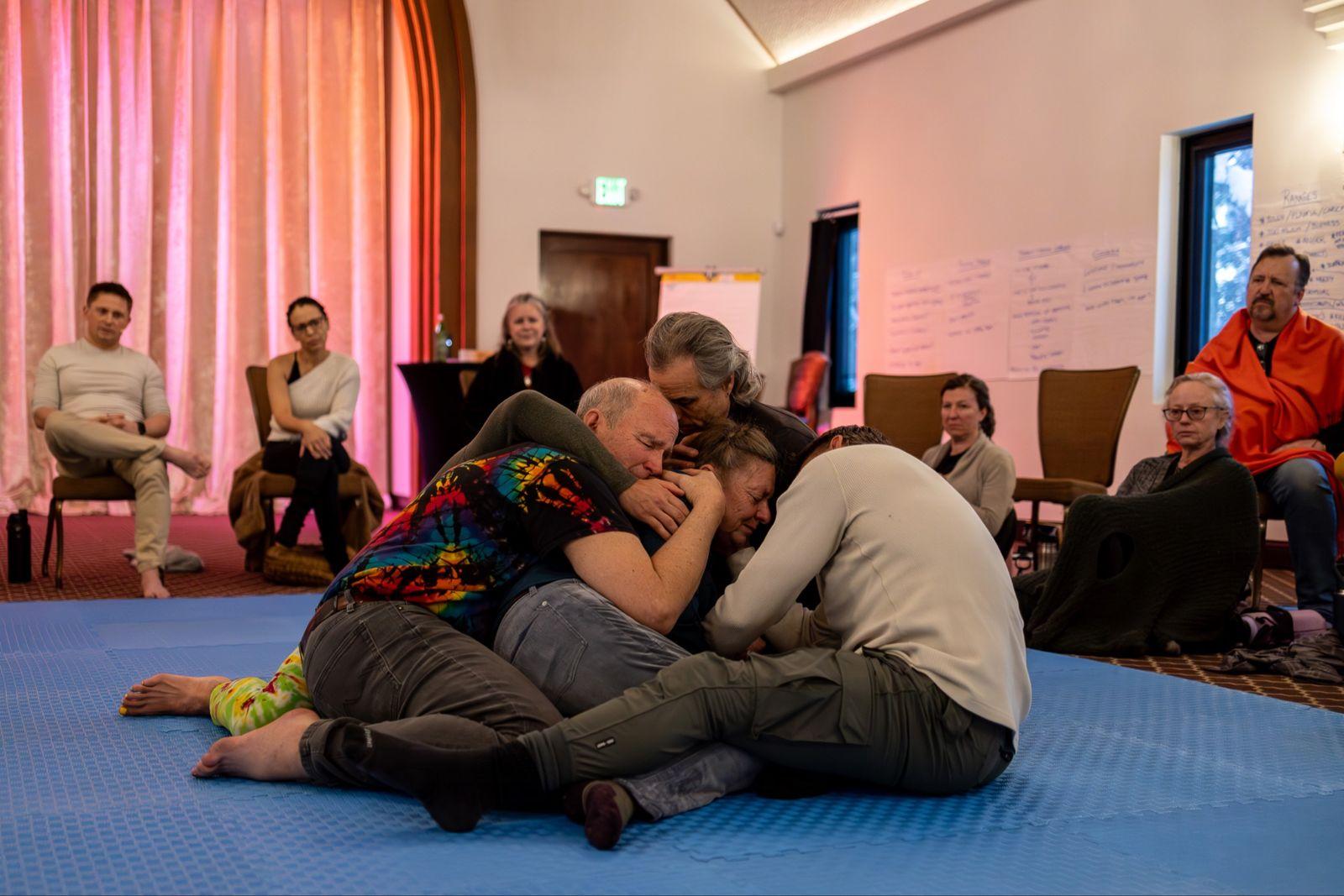
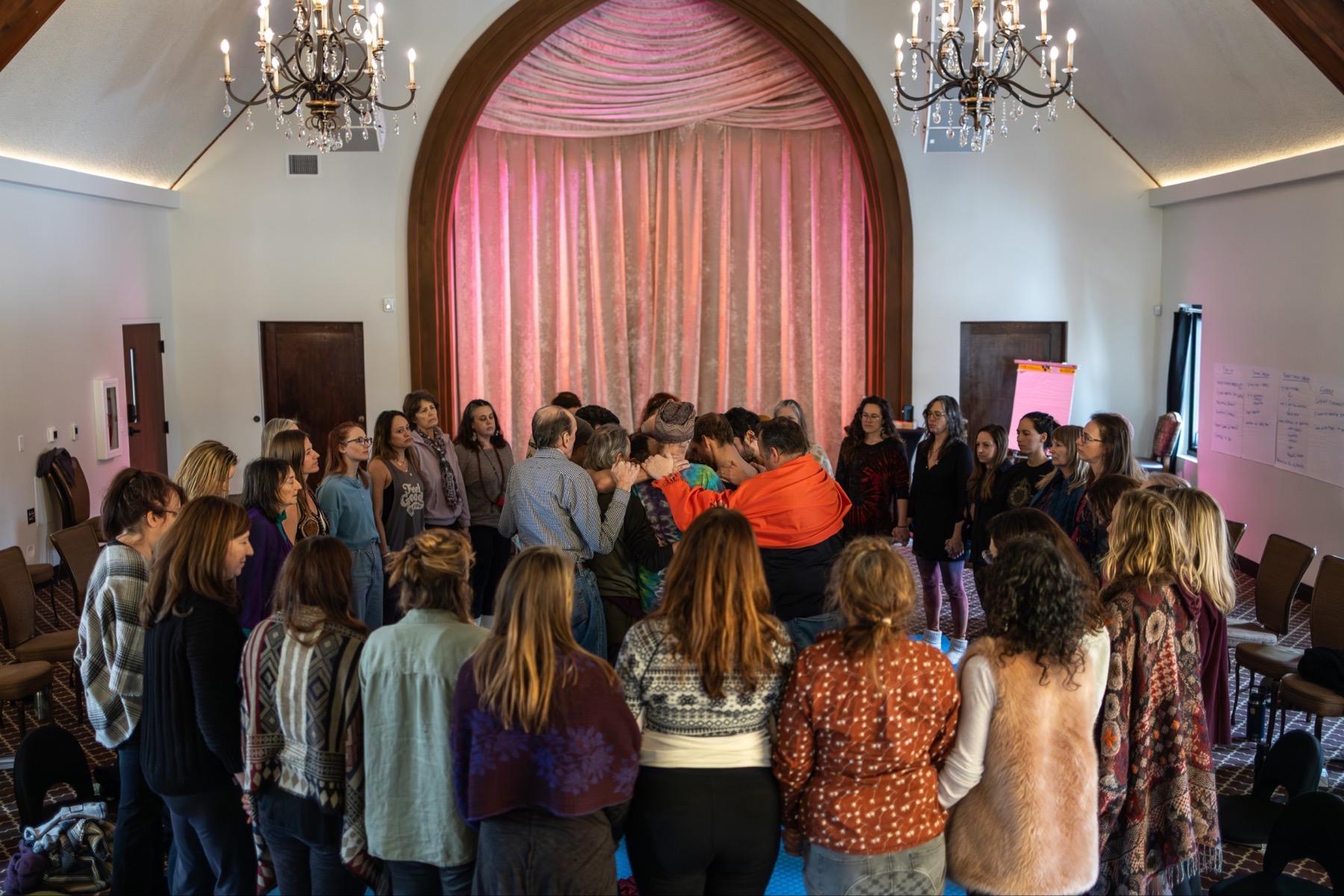
The practice moves between three settings. Alone, you widen what your body can hold. In pairs, structured ways of speaking and listening keep two people connected through the conversations that usually break connection. And in a circle, a small group brings its combined attention to one person at a time, which makes it easier to feel yourself than it ever is alone. That group dimension has its own full introduction on the circle work page.
The map
What are the four directions of capacity?
The map at the centre of Heart iQ is simple enough to draw on a napkin. In any moment your system is either open or closed in four directions. Two are vertical and two are horizontal, and they meet in the heart.
Your capacity to feel connected to something larger than you. To feel held by life, and to feel awe and wonder even when things fall apart. For some people this opens through prayer or meditation; for others it opens in a forest.
Your capacity to feel what is happening inside: sensation, emotion, the ground under your feet. This is embodiment, and it is where most people begin, because a numb body cannot feel joy either.
Your capacity to let love, attention and care actually land, without deflecting, shrinking or paying it straight back. Christian calls this work expanding the thimble: most of us can only receive a thimbleful before we look away.
Your capacity to be all of you in front of other people. To say the true thing, show the tender thing, and stop shape-shifting to stay acceptable.
When any direction shuts down, we compensate. We override, we numb, we perform, we withdraw. The compensations are so familiar that most people mistake them for personality.
You will sometimes see these four drawn as two ranges rather than four directions. Up and Down together make the vertical range, the full channel between something larger than you and the ground beneath you. In and Out together make the horizontal range, the give and the receive of being met by another person. Both descriptions are the same map. Around both sits the field, the living energy between people, which is what makes a circle able to carry someone further than they could go alone.
Joy, in this work, is what flows when all four directions are open at once, which is why the training never treats one skill in isolation. Going “more up” when you feel disconnected rarely works; dropping down into the body often unlocks the vertical range instead. The directions are one system, and the heart is where they meet.
Why does Heart iQ train capacity instead of insight?
Insight tells you why you close. Capacity decides whether you can stay open anyway. Many people who find this work already understand their patterns well: they have read the books, they can name their attachment style, they know exactly what they do when they feel hurt. Then the moment arrives, a partner says the thing that usually ends the conversation, and the knowing counts for very little. What counts is what your body can do under that pressure.
Christian draws the distinction with a jacuzzi. A peak experience feels wonderful while you are in it, and then you climb out and go back to whoever you were. Capacity is a baseline rather than a state you visit. It is there the moment you wake up, in your work, in your relationships, in the way you carry yourself through a hard conversation. A single profound experience changes something temporarily; repeated experience changes something permanently, which is why Heart iQ is a practice rather than an event you attend once.
The orientation follows from that. If your system learned to guard and filter, then even in the presence of real love and real care the felt experience is still one of lack, because only a thimbleful can land. So the work does not begin by trying to get you more of anything. It begins with the vessel itself, your nervous system and your relational range, and gradually expands it until more of life can move through you without overwhelming you or being shut out.
None of this discards insight. You cannot change what you cannot yet see, and part of the practice is learning to track what is actually moving in you from moment to moment. The order is what changes: seeing serves opening, rather than replacing it.
Why is Heart iQ practised with other people?
A signature line from the work carries the answer: what was wounded in relationship needs relationship to heal. Nobody wounds themselves alone in a room. The original closures formed in connection, usually in moments when someone should have been present and could not be, which is why they never fully unwind through thinking, belief change or solo practice. The part of you that learned to expect harm from connection needs a different experience of connection, offered slowly and repeatedly, until the body believes it.
Other people also reach what you cannot. Some of what holds you back sits in blind spots that no amount of private reflection can find, because those patterns only wake up in contact. And when a group rests its combined attention on one person, everything in them becomes clearer and easier to feel. Christian compares that gathered attention to sunlight through a magnifying glass, and the work calls it the amplified field. Inside it, emotions are more available than usual, and words arrive for things you have never managed to say.
None of this asks any one person to carry your healing. A partnership is a sacred container, and there are needs it cannot meet on its own; some closures ask for the attunement of a group. That is the reason circle work sits at the centre of the practice, and it is also why nobody is ever pushed there. You choose whether to share, you can step back from any exercise at any point, and consent is treated as ongoing rather than assumed.
The deeper purpose
What is Heart iQ ultimately for?
Underneath the capacity work and the relational skill sits something Christian calls Unity Consciousness: the emergent wisdom that moves through a group once it becomes coherent, and the felt experience of moving from me to we.
The idea that we are all one is not new, and most people who find this work have met it before as a concept they agree with. The question Christian could not put down was different. He knew it, and he wanted to feel it in his body. Heart iQ is what came out of trying to close that gap, so that oneness stops being a belief and becomes an experience a room can actually have.
The same movement is needed at every scale. Inside one person, it happens among the community of parts that live in them. Between two people, it allows intimacy to hold. In a room, it lets something real move.
What happens in a circle is small, and it is also a working model of something much larger.

Where did Heart iQ come from?
Christian Pankhurst began his working life as a chiropractor, and early in practice he noticed that many of his patients’ physical symptoms carried an emotional story. So he ran an experiment. Instead of adjustments, he invited a group of patients to evening workshops on feeling their emotional and energetic life, then watched their symptoms shift. The results unsettled him enough that he left the profession and sold what he owned, then went looking for teachers.
Over the following years he studied group dynamics with seminar leaders across Europe, Australia and the United States, spent a year as the protégé of Neale Donald Walsch, author of Conversations with God, whose central teaching that we are all one left Christian with the question that has shaped everything since: he knew it, and he wanted to feel it in his body. He was mentored in circle work by Tej Steiner. In 2009 he won Britain’s Next Top Coach, a public competition whose final round was a single-take, ten-minute coaching session put to an open vote.
The method that emerged from those years of live facilitation became Heart iQ. In 2016 Christian and the Heart iQ community established New Eden in the Netherlands, a residential centre created specifically for immersive group work. His book Insights to Intimacy lays out the relational teaching in written form, and there is more of his story on the about page.
How can I meet the work?
Reading about a felt practice only goes so far; at some point it has to land in the body. Start wherever you feel drawn.
- Begin with Heart iQ Foundations
- See upcoming retreats and immersions
- Explore Heart iQ Mastery
- The Healing in Tribe immersion
- Get in touch
If you are a coach, therapist or circle leader drawn to holding this work for others, start with the free three-part video series on how Circle Work operates or go straight to the facilitator training page .
Come and feel it for yourself
Capacity is built in company, and the easiest way to understand this page is to feel the work it describes.