
In Heart iQ, I use unconditional love to describe a willingness to meet the full range of our experience. The image is of white light passing through a prism: many colours belonging to one spectrum. It is a spiritual and experiential metaphor, rather than a claim that every emotion feels pleasant.
We need to joyfully behold and consciously experience this beautiful contrast afforded by life as this is what creates true depth of feeling.
This is what your Heart yearns for: To Feel More & To Be More.
Making room for more of yourself
The practice is to notice what we habitually reject and explore whether there is a kinder way to relate to it. Acceptance of a feeling does not require acting on it or allowing harmful behaviour.
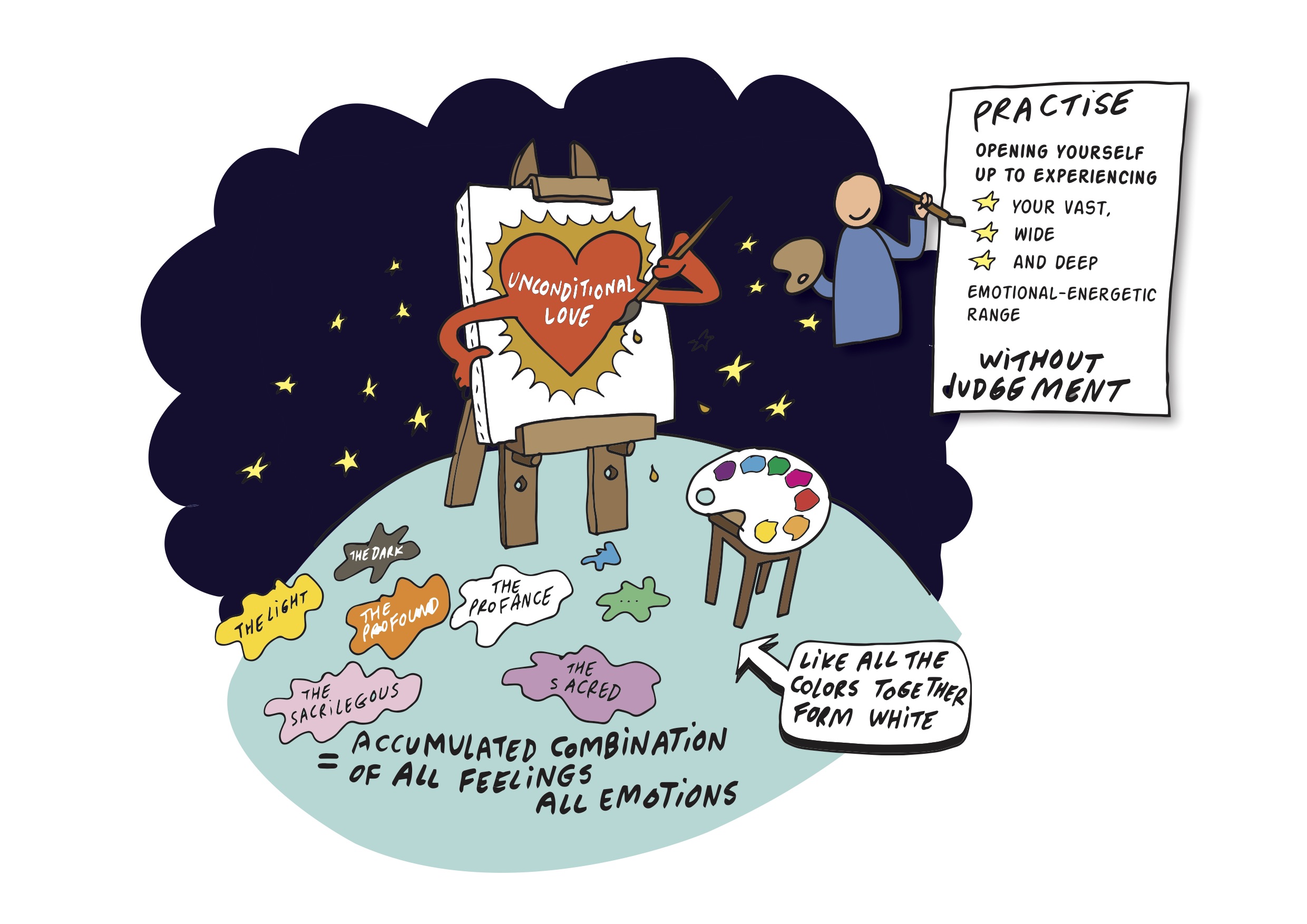
In a relationship, if either partner is limited in their ability to express some part of their range, they will also be limited in their ability to experience the other from unconditional love. Why? Because your ability to open and love another is intimately linked to the quality of your relationship with yourself. The good news is that when you expand your emotional range, you also expand your capacity to love unconditionally. The more you can allow all of you to be seen, heard and felt, the more your heart can safely open.
Loving you means loving all the parts of you - your light and dark parts; your good, bad and ugly parts; and the parts you deem unlovable and unacceptable. Embracing our ‘all’ isn’t easy to do given how conditioned we are to judge these parts as being ‘negative’, ‘wrong’ and not safe to expose.
In the next video, Christian busts the myth of ‘negative emotions’ and addresses a key Heart IQ™ concept called divine embodiment.
Contrast and emotional range
-
In the recording, I speak strongly about finding enjoyment in emotion. That describes a possibility I explore in my work. Painful feelings are not a failure of the person experiencing them, and no one needs to find them enjoyable.
-
The contrast image suggests that trying to remain only positive can narrow how much of ourselves we acknowledge. Owning anger, sadness or uncertainty may allow a more honest expression. How that unfolds differs from person to person.
-
Divine Embodiment is the process of integrating your highest spiritual essence with your humanity, living out your deepest truth in a practical and grounded way.
From the Recording
These two clips expand on the written piece and give the teaching behind it in Christian's own words.
Divine Embodiment
Christian describes love arriving through the body the way white light passes through a prism, splitting into a full spectrum. He calls the process of letting that whole spectrum move through you 'divine embodiment', taking the goodness within you and giving it voice through your humanity rather than living only in a spiritual bypass or only in human drama. When part of that range is not allowed expression, he says it can form a shadow, and it is often the parts we've labelled wrong (anger, sadness, jealousy) that get denied rather than felt.
The Contrast Image
Christian references an image of two circles, one poorly defined because the foreground and background are too similar in tone, and one sharply defined because of strong contrast. He uses this to make the point that owning your darker or less flattering qualities is what makes your light more vivid, rather than trying to stay only positive, which he suggests can flatten your emotional range and reduce access to joy as much as to difficulty.
Contrast and Emotional Range
Poorly Defined Circle
When you avoid or judge your darker feelings, the contrast is too low and your brightness can feel flat.
Well-Defined Circle
When you allow both dark and light feeling, the contrast sharpens and your light shows more vividly.